

Have questions or interested in our premium window solutions? Reach out to us—we're here to help!


Through the use of brain-computer interfaces (BCIs), people who are paralysed can once again connect with their surroundings by controlling robotic limbs, wheelchairs, or computer interfaces.

BCIs allow ALS patients who lost voluntary muscle control to communicate via speech, text, or control systems.

BCIs can be used to control assistive devices or for neurorehabilitation by stroke survivors with motor deficits, increasing their freedom and mobility.

Patients with SCI can operate gadgets directly with their brain signals by means of BCIs, which bypass compromised neural circuits.

Diseases like Parkinson’s disease or multiple sclerosis can be managed with BCIs to manage symptoms. It also helps with communication and movement.

It helps individuals to communicate properly if they are suffering from conditions like locked-in syndrome, where they can’t communicate verbally or physically.

It helps in controlling neurostimulation devices or seizure detection systems.

Electrodes are positioned close to certain relay areas on your head in order to record the intended brain activity accurately. These electrodes act as sensors that detect voltages associated with the brain activities. The frequency and intensity of each voltage spike is measured and each activity is recorded. The system feeds this information into specialized computer software, where it’s translated with the process called neural decoding. Various machine learning algorithms and other artificial intelligence agents play a vital role in conSignifiverting complex data collected from brain activity into a programmable understanding of the brain's intention. After the Brain-Computer Interface (BCI) translates brain signals into commands, the patient can act by controlling the output device, such as a robotic limb
It is actually a computer-based system that receives, processes, and converts brain signals into commands. It doesn't read minds or extract information from your brain without consent. Instead, this technology lets users control devices using brain signals instead of muscles. After training, the user generates brain signals reflecting their objectives and decisions, and the BCI translates these signals into commands to operate devices, allowing them to act on their intentions.
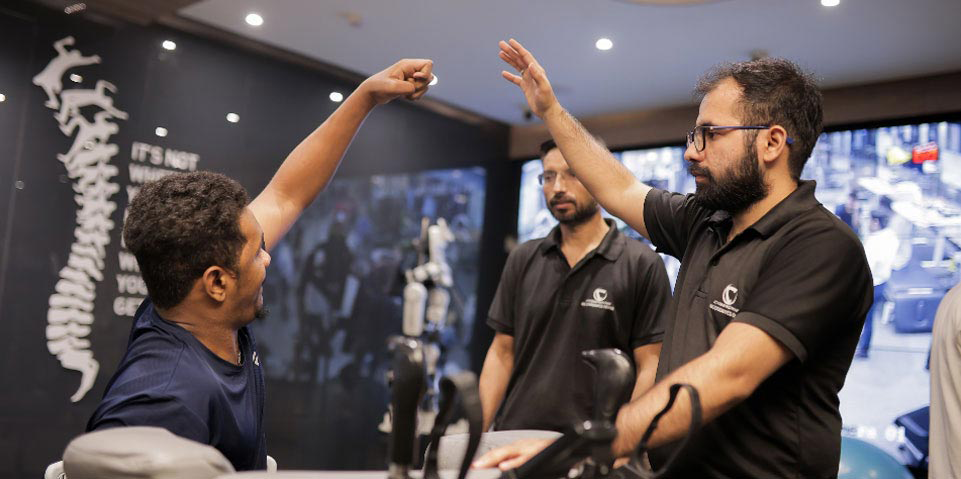
Following are the key impacts of BCIs on patient recovery:
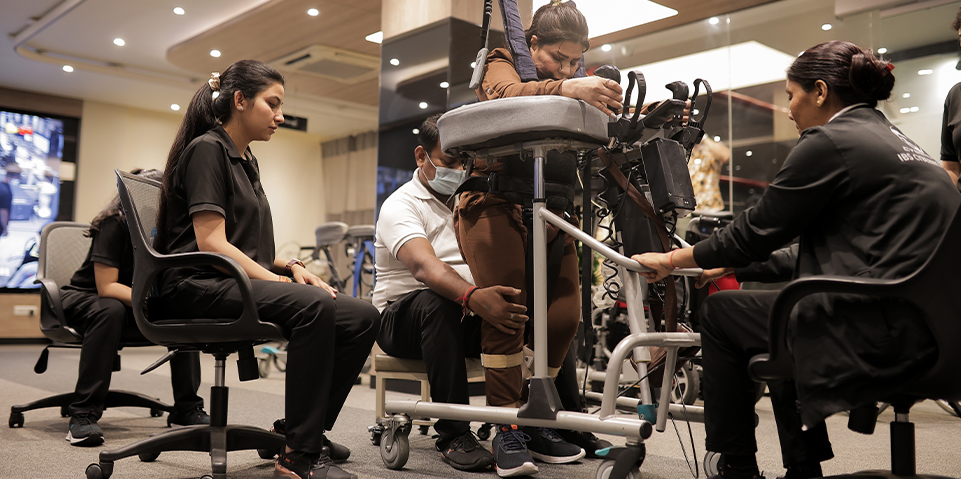
Following are the Brain Computer Interface (BCI) advances that may become reality in the near future:

 View
video testimonial
View
video testimonial
 View
video testimonial
View
video testimonial
 View
video testimonial
View
video testimonial
 View
video testimonial
View
video testimonial

Your brain has the amazing capacity to reorganize and recover, regardless of age or the severity of your neurological disorder/injury. Effective recovery is achievable with high-intensity neurorehabilitation and appropriate support. Because of neuroplasticity, the brain's innate capacity to adapt and establish new connections, recovery is possible at any stage with focused approach and expert direction.

Your brain has the amazing capacity to reorganize and recover, regardless of age or the severity of your neurological disorder/injury. Effective recovery is achievable with high-intensity neurorehabilitation and appropriate support. Because of neuroplasticity, the brain's innate capacity to adapt and establish new connections, recovery is possible at any stage with focused approach and expert direction.

Your brain has the amazing capacity to reorganize and recover, regardless of age or the severity of your neurological disorder/injury. Effective recovery is achievable with high-intensity neurorehabilitation and appropriate support. Because of neuroplasticity, the brain's innate capacity to adapt and establish new connections, recovery is possible at any stage with focused approach and expert direction.
For those impacted by spinal injuries, spinal cord injury rehabilitation aims to improve strength, mobility, and overall quality of life.
 New
Delhi: +91 9035030623
New
Delhi: +91 9035030623
 Hyderabad: +91 9035030623
 Bengaluru: +91 9035030623
 Malaysia: +606 235 4000
 Muscat:
+968 22 496007
Muscat:
+968 22 496007